
 Artificial Intelligence
 Consulting
 Development Services
Something fundamental has changed in how technology companies staff their most critical work. The old playbook looked something like this: post a job, hire full-time, repeat. That process is giving way to a more agile model built on contract talent, staff augmentation, and contingent labor. And the numbers are impossible to ignore.
The contingent labor model, which includes contract developers, staff augmentation, and project-based specialists has graduated from a niche workaround to a core workforce strategy. According to the Bureau of Labor Statistics, 6.9 million Americans held contingent roles as their primary job in 2023, a figure that has only climbed since. Industry surveys suggest that independent and freelance workers could make up a significantly larger share of the U.S. workforce in the coming decade, potentially approaching or exceeding 50% if recent growth trends persist.
For IT organizations, the shift is even more pronounced. Technology roles are project-oriented by nature. A cloud migration has a beginning and an end, an AI implementation requires skills that may not exist on permanent payroll, a cybersecurity audit demands expertise that would be economically absurd to hire full-time. The contingent model was, in many ways, built for how tech work actually happens.
The Real Economics: What the Numbers Actually Say
The conventional wisdom used to be that contractors cost more. On a per-hour basis, that’s technically true. A full-time software engineer earning $100,000 per year works out to roughly $48 per hour, while a contractor with equivalent skills might bill between $75 and $150 per hour. But the sticker price comparison misses the full picture.
When you account for employee benefits, health insurance, 401k match, PTO, parental leave, payroll taxes, onboarding costs, equipment provisioning, and the very real risk of carrying idle headcount during slow periods, the math flips considerably.
According to BambooHR data, companies spend between $7,500 and $28,000 in hard costs to find and onboard a single new employeeб before they’ve written a line of code. Contractors arrive pre-vetted, with a typical time-to-productivity of 2 to 4 days versus 2 to 4 weeks for permanent hires.
Staffing agencies typically add markups of 30–60% on top of contractor rates, but even factoring those in, organizations that strategically manage their contingent workforce report labor cost savings exceeding 10%, and 84% see measurable reductions. Companies using Managed Service Providers (MSPs) save an average of 15–20% on total contingent workforce costs, driven by rate standardization, vendor consolidation, and reduced compliance risk.
What Small, Mid-Market, and Enterprise Companies Are Doing
The contingent model isn’t one-size-fits-all. How organizations approach flexible staffing varies enormously by company size, risk tolerance, and workforce maturity. Here’s what the landscape looks like across the spectrum:
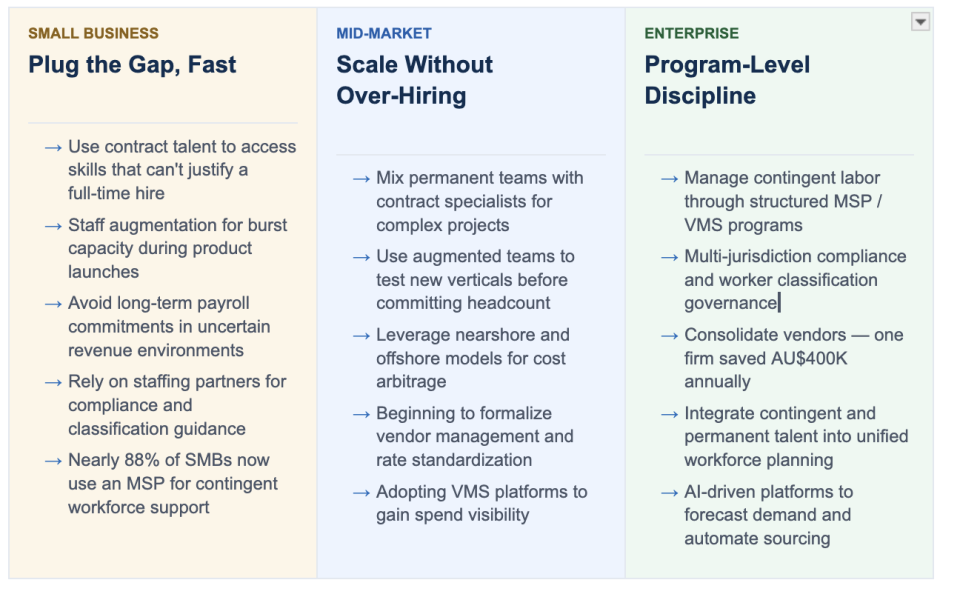
The gap between enterprise and SMB approaches is narrowing rapidly, driven by affordable VMS platforms and staffing firms that bring enterprise-grade compliance infrastructure to mid-market and growth-stage clients. What was once a differentiator for large organizations is increasingly accessible to any company that partners with the right provider.
The Skills Driving Demand
Artificial intelligence and machine learning top almost every contingent demand list, whether it’s building a custom LLM integration, implementing a predictive analytics pipeline, or auditing a model for bias. The cybersecurity talent gap is estimated at 4.8 million unfilled positions globally as of 2026. This is generating similar urgency around contract security engineers, penetration testers, and compliance specialists. Cloud architecture, DevOps, and platform engineering round out the top tier.



The IT staffing industry is projected to grow at nearly 7% globally in 2026, largely driven by demand for niche skills. With 4.7 million independent workers in the U.S. alone earning over $100,000 annually, the available talent pool for high-value contract engagements is deeper than it’s ever been.
The Hidden Risk Nobody Talks About
For all the momentum around contingent hiring, there’s a structural vulnerability that trips up organizations at every scale: visibility. When departments source contractors independently, IT brings in consultants, marketing hires freelancers, operations contracts temp workers, total spend becomes impossible to track, and compliance becomes a game of chance.
The fix is straightforward: centralize, standardize, and partner with a provider who owns the compliance burden. A structured staffing partnership will help lower hiring costs, improve talent quality, reduce time-to-fill, and dramatically reduce legal exposure.
